Tuesday, 24 May 2016

Archive Interview - Penetration (interviewed in August 2015, prior to the release of 'Resolution')

Last Sunday afternoon I had an interesting chat with a band about old music and new music. Nothing unusual in that, you might think. Except that the band in question were the legendary Penetration, the old music that we discussed was the shifting of tectonic plates that was punk rock and the new music that we chatted about was Penetration’s first new album in 36 years.

I started by asking the most obvious question of all. Why record and release a new album now?

Rob “On the last lot of gigs it became apparent that we were becoming almost our own tribute band. We’d been out doing shows now since 2002 and not done anything seriously in the studio; a couple of 7” singles came out but that was it. After the last lot of gigs we felt that to make ourselves a proper band that we’d make a record. It kind of brings you together really, it unites you as a team when you make a record in the studio. I knew that we’d make a good record as well because I had it in my head how I wanted it to be.
”
Neil “Was then album ready to go when you announced the Pledge campaign to record it?”

Rob (firmly) “No”  (they all laugh.)

Neil “Was it a leap of faith?”

Rob “It was, in a way. Pauline did some solo shows in Australia and when we came back we kind of made our minds up. The thing I liked about the Pledge campaign is that you give yourselves a deadline and if you don’t do that you would never get an album finished.”

Pauline “Once we pressed that button for the Pledge campaign at the end of January and the counter started going around like that (Pauline makes a clock hands gesture at this point) and it got to 100% quite quickly, I thought ‘Oh my God, shit’.  At that point all we had written was ‘Guilty’, we’d already done ‘The Feeling’, we’d already done ‘Sea Song’. ‘Two Places’ we’d had for quite a while but hadn’t really done anything with it and we had a few little ideas kicking about. The drummer that we had had left, so we were drummerless at that point as well. Rob had the idea of a team of people to put together, he’d already gone into asking John Maher, Fred (Purser), all of that.”

Rob “I knew exactly how we wanted it to be. I knew we wanted to work with Fred, we wanted it to be a Penetration album, we wanted to have that sound. So I sat down with Fred and we had a couple of nights talking and chatting about what the album would sound like and where we were going with it. I can hardly remember anything about recording the first album, or the second album to be honest with you, but he knew the whole process so we compared notes as to how we were going to do it.”

Pauline “It was an absolute team effort. At that point we had the basic chords for ‘Just Drifting’ but we had no lyrics. We had the basics of a song that became ‘Betrayed’. I always knew that we would come to a sticky point three quarters of the way through. John came down, he lives on the Isle of Lewis, maybe four consecutive weekends to do the drums.”

Paul “There wasn’t any panic though, I was really confident we could make a good album.”

Neil “Does it feel like a natural progression because it certainly sounds like one? It doesn’t feel like there’s a gap of 36 years.”

Steve “I’m interested in you saying that because it was always a big thing was that it was going to be ‘the next Penetration album’ .”

Pauline “We needed to retain the essence of what Penetration is. I stand back in the writing so that the guitarists or whoever can come up with the chords because that’s the way Penetration used to do it and then I shoehorn into that. You’ve got the two guitar thing going on, you’ve obviously got Rob who’s there from day one, you’ve got my voice from day one but you’ve also got a wealth of experience to draw from as well.”

Neil “I find this an interesting concept, bringing a wealth of experience to, what was on those early albums, as much about youthful exuberance as anything else.”

Pauline “Oh yes.”

Paul “I think experience can bring its own problems, because what you don’t want it to sound is contrived or planned with an eye on a certain area, but it was so natural the way that the album was made that very quickly that issue just disappeared.”

Pauline “And it unfolded as it wanted itself to. We just did whatever we thought was necessary and it didn’t matter if it fitted in that bag or that bag. We wanted to make an album, not a series of tracks, we wanted to make it a whole thing, a whole listening experience. Originally we wanted a lot of the tracks to run into each other because we didn’t want the scenario that you have these days where you have the download where you go ‘oh, I’ll have track two. I like track three’ where they never know the titles. We wanted it so that it should be listened to as a full album.”

Paul “I think that’s right, down to the fact that we thought of it as two sides as well. We were thinking of a vinyl album, the length of a vinyl album, well some of us were.”

Pauline “We wanted to make a proper album.”

Neil “If we can backtrack almost 40 years, is it true that you formed after seeing the Sex Pistols perform live?”

Pauline “I think we were already sort of formed before that, because we were practicing and we were doing complex stuff like ‘Roadrunner’ and ‘Pills’ by the New York Dolls and I think that was slightly before or around about the same time. But seeing the Sex Pistols you knew that something new was going on, you knew that that was the past and this is now. We probably started to form the band slightly before.”

Rob “Yeah, I think you’re right, although I wasn’t part of it then. I was the mate with the car.”

Neil “But it’s very obvious when listening to the original Penetration albums that you had influences that were earlier than that.”

Pauline “Oh, absolutely. I was going to see bands from the age of fourteen. I was very, very lucky.”

Neil “Where did you go to see them?”

Pauline “Mainly the City Hall, or The Mayfair or Middlesbrough Town Hall. I even travelled, I saw the New York Dolls at York University, Lou Reed at Crystal Palace Hall when I was about fifteen. I saw all the great bands that passed through, Bowie when the City Hall was three quarters full, Bowie at Sunderland Top Rank, Roxy Music, Cockney Rebel. I saw all of that early ‘70s stuff, and I mean all of it, anything that was worth seeing. Prior to the punk thing I saw Bruce Springsteen’s first gig in this country, prior to that you started to get the American stuff coming through, Patti Smith’s ‘Piss Factory’, ‘Little Johnny Jewel’, those sort of independent releases, Ramones, Jonathan Richman. So that was prior to the Pistols really. I was very influenced by that New York, American scene prior to punk and I think what you got in this country was the attitude. It was like ‘we don’t give a fuck’, like ‘hey we’re young, this is our world, you lot have got it all wrong’. It just felt like something that we could claim. To me punk was about being inventive, following your own muse, doing something that was unique to you. So, yeah, I was really switched on and (to Rob) you were as well.”

Rob “Yes, from thirteen, fourteen, there was stuff we’d go to see. We’d go to the same gigs.”

Steve “I started going to gigs in the late ‘70s. I was going to gigs in Sunderland, I remember going to Sunderland Mayfair to see The Stranglers.”

Pauline “I was really lucky, I was fourteen and I had an older boyfriend who was four years older than me and he was really switched on. I was so lucky; I was young to be going out seeing all that stuff. I had very understanding parents, looking back.”

Neil “I feel that this album messes with my concept of what came next because it was always the Pauline Murray and The Invisible Girls album that came next for me, yet this new one seems to somehow fit in between.”

Rob (to Pauline) “You had that theory, didn’t you, that this is the missing link?”

Pauline “Well I actually think that. I think this album is the missing link between the third Penetration album and The Invisible Girls.”

Steve “It’s jumbled into one isn’t it? We set it up within the framework and idea of it being a Penetration album and tried to put the certain elements in place, but then all the stuff that you’ve done in the past gets thrown into the pot as well.”

Neil “So who do you find exciting musically now?

The response is a brief silence, then nervous laughter.

Pauline “Ha, a resounding silence.”

Paul “I don’t like a lot of contemporary stuff, but that said I do listen to a lot of radio 6. I hear it and there’ll be something that I’ll like. It’s almost like you know too much, like ‘well I know where that’s come from’ and for me I’d rather go back and listen to where it originated. Since Penetration split and since The Invisible Girls album we’ve had this thing called post-modernism and it’s changed everything.  And we’ve had technology and that’s changed everything. It’s a different listening experience, a whole different experience of how we take in popular culture now. I think it’s a more superficial activity, even for younger people, not just for us. I do think White Stripes made some brilliant music actually, but I don’t really go out and buy the records. It’s around and if I hear it I hear it.”

Pauline “There’s a lot of good original stuff around, there really is but it never gets out there, that’s the problem.”

Rob “There’s a lot of people from around the ‘80s that’s still making great music. Nick Cave is still making great albums, and Morrissey is still making great albums I think.”

Paul “That air of cynicism just used to go through pop music and those commercial areas but now that cynicism goes through the independent scene as well and the alternative scene, or the left-field scene and you just don’t feel there’s an air of authenticity. Look at Mumford and Sons, that hideous band, their latest album suddenly they’ve gone all electric. You know it’s a marketing issue; it’s not a creative issue. It’s like ‘well you know we’ve done that folk thing that people are starting to not really like as much, we’re a bit uncool, we’ll make the next one electric.’”

Rob “And get our hair cut!”

Paul “and you just think ‘oh, fuck off!’”

Pauline “I think people just aren’t turned on to music any more. They’ve become very distracted by what the mass people are interested in. Money, how big it is, if everybody wants to go to it, coffee table band music really. They’ve even turned on to Nick Cave now ‘oh yes, we’re going to see Nick Cave’”

Rob “Nick Cave at the Sage. Oh dear!”

Paul “The metropolitan media elite, they decide suddenly that someone like John Cooper Clarke is the nation’s favourite.  We knew that in 1977”

Rob “He’s doing nothing different to what he was doing back when there was only 200 people turning up to his gigs.”

Paul “It’s interesting because I think that people say that the music business is in trouble, and it is, but the media are more in control of the whole thing now, than they ever were when punk broke.”

Pauline “With the punk thing people took ownership of their own movement, but it was soon infiltrated and used by others.”

Rob “And there was great journalism as well.”

Pauline “You don’t really get writers like that any more, where people will analyse something. They cut and paste your press release now. You think ‘well could you not get your own angle on that, what’s the matter with you?’”

Paul “There were some writers at that time that tended to over-analyse and be pretentious but that was part of the fun of it, you could always pull them up if you thought they were going too far. Certainly that kind of analysis of music, there’s a lot of that disappeared now.”

Neil “When we lost John Peel, did we lose the last of the pioneering disc jockeys?”

Rob (as if to egg Paul on) “Go on.”

Paul “That fucker was well past his sell-by date! I think this thing about John Peel, he’s held up as some sort of hero and he wouldn’t have had a show without the music. He made a decision to start playing punk music when two months before he was playing Jethro Tull and Yes and things like that and it was really the bands that made the music.”

Neil “Was there a switch flipped that changed things from Pink Floyd to punk?”

Pauline “Oh, there was.”

Paul “There was a proper paradigm shift and that should never be forgotten. It happened within days.”

Pauline “I saw it happen before my eyes. For instance I went to see the Doctors of Madness at Middlesbrough Town Hall, and I’d been to see them quite a lot, they were a left-over from the Glam era which I loved and the Sex Pistols supported them and they made that band obsolete there and then. And that was it for that band. It was as quick as that, and a lot of those old bands were frightened by it because they knew their time was up.Young people were out there, making their mouths go and those people had had it good. Whoever hadn’t behaved themselves right were turfed out. Some people made it through, like Iggy Pop made it through, Bowie made it through, Lou Reed made it through, some people did make it through; Marc Bolan did to an extent. He embraced punk and they embraced him, but a lot of the excessive early ‘70s people were laid to waste overnight and it was definitely an immediate type of shift. You just turned your back on them, and I’d loved a lot of those bands.”

Paul “All those people who talk about when punk hit it was like they were out at sea and there was a fucking storm and the ones that knew how to sail, this is a terrible analogy isn’t it, that knew what they were doing, who were experienced and clever, they saw it out and they found calmer waters.”

Rob “A lot of people just went to ground didn’t they? Just disappeared off to Bermuda for five or six years.”

Paul “And I think history has proved that we were probably right as well.”

Pauline “Nobody can put their finger on it though. They try to analyse punk again and again. They’ve picked over it so much that there’s nothing left to analyse. But they still can’t get a handle on it.”

Rob “It was a point in time as well wasn’t it?”

Steve “I don’t think that our age can ever be recaptured though can it? The people who were being outraged were the ones who’d came through the war and were looking for an easier life and the youth were coming up and wanted to kick against this easy life that everybody had. The people in power and local politicians were people who’d been in the forces, so they were easily outraged by these kids who were bored and constrained. And you’ll never recapture that kind of outrage. There were questions in Parliament about punk rock. You’re never going to get that about any music culture again. That outrage can’t be replicated.”

Pauline “And the hippies were put in their place. All the sixties people who had pioneered for this and that had suddenly turned into the capitalists of the day.”

Paul “We had a tailor-made enemy with the hippies.”

Pauline “Never trust a hippy. Malcolm McLaren said that and no truer word was said. I will always use that as a yardstick. Never trust a hippy. I’ve found it to be very true on a lot of occasions.”

Neil “I’ve recently seen Penetration described as a ‘first wave’ punk band?”

Paul “There’s no argument that Penetration were a ‘First wave’ punk band. They played The Roxy, I think it’s very important that the single came out in 1977.”

Pauline “Musically everything comes from something else. The Pistols were very like ‘60s, Small Faces, traditional really.”

Steve “They were souped-up Mods really.”

Pauline “The music was pretty traditional when you think it was coming from something that already existed, as Jonathan Richman would have been coming from The Velvet Underground. Everything is connected; nothing is set on its own. What set The Pistols apart, because musically they were fairly conventional, was the lyrics and Johnny Rotten’s delivery of them.  And his look, his intensity.  I’d never heard anybody sing ‘God save the Queen, she ain’t no human being, she made you a moron.’ I had heard something like ‘Pretty Vacant’ previously in something like ‘Blank Generation’ but, lyrically some of the things that he was coming out with, he would have been hung, drawn and quartered in another century, uttering those words out into the open like that.”

Paul “But to them that was very natural, that wasn’t contrived either.”

Pauline “It takes a lot of courage to come out with those things when no-one’s ever said them before. I can’t think of anyone who’d said stuff like that about the establishment.”

Paul “I don’t think even they realised how inflammatory it was. I think they were just doing what they were doing; they were having fun. I think even they were taken aback.”

Pauline “What did they have to lose? What did any of us have to lose? We were all from working class backgrounds; what did any of us have to lose? Nothing really. We just saw it as a bit of fun at the time, a bit of a laugh. I didn’t think 36 years later we’d still be sat here talking about it.”

Neil “I know that you’ve played live gigs recently, but it must feel different playing to promote a new album.”

Pauline “Ooh, it’s going to be really different. We haven’t started bloody rehearsing yet and we’ve only got four weeks to go. And we have a drummer who’s in the Isle of Lewis, we can’t get him down here all the time. It’s going to be very different to the last time we went out.”

Steve “There’s a lot of tracks which were just worked out in the studio. We’ll have to re-work them out and see which tracks work best live.”

Neil “How much of the new album are you going to play live?”
Pauline “Quite a lot, I would say.”

Rob “We’ve sort of worked out a set list and it includes most of the new album.”

Neil “Was it important to you to have a ‘physical’ release?”

Rob “The record buying public is going back to physical purchases. This was mixed in a studio to be listened to on a hi-fi system.”

Neil “It’s true that most people now don’t listen to music on particularly good systems.”

Steve “They listen to it on shit! Most modern music sounds shit. Most modern music players sound shit. MP3s are shit, by their nature. It nearly all sounds shit and it’s on shit players everywhere you go.”

Paul “And we asked Vaughan Oliver to design the sleeve as well, because it’s a whole physical package and we wanted that quality and that kind of experience.”

Steve “It’s the people who wanted the physical package who enabled this album financially.”

Rob “The Pledge campaign didn’t have a ‘download only’ option, we made sure it didn’t. It was always going to available physically, on CD, or, if you buy the vinyl you get a download code. It was never intended to have just a download option.”

At this point I thank the group and wish them good luck with the album’s release.

Paul “We know it’s a great record so any criticism is like water off a duck’s back. You’re always going to get that. The most frustrating thing to me would be to be ignored. It’s better to be hated than ignored. I think that quiet confidence that we all had throughout it is key.”

Rob “And the live gigs are going to be more exciting for us because this adds an extra element playing brand new songs. It’s just going to add to the tension, to the excitement for us.”

Paul “We’re not idiots; we’ve all been to see bands where we’ve sat through the new stuff, just waiting for the classics. We know that, but we think that at least 50% of the set is going to be new stuff because we’re excited about playing it. That will come across. I think it will also help the old material as well. I’m just ready to start stuff now, my fingers are itching.”

Pauline “We want as many people to hear it as possible because it’s all done for the right reasons.”


Please don't forget that you can download and read 'The Great Cassette Experiment' and 'Writing About Music' from Amazon and Google Play Books. 


Archive Interview - Scorpio (interviewed April 2016)

The history of Scorpio, Mele Mel (only one ‘l’ in ‘Mele’ now, apparently), Grandmaster Flash and the rest of The Furious Five is a complicated one. In many ways it’s easier to just accept that the past is the past and glory in the news that there is a future for the hip-hop trailblazers. I chatted to Scorpio, an original member of The Furious Five recently and he started, as all interviews should but few do, with a full introduction;

“First I’d like to introduce myself. I’m Scorpio from the original rap group Grandmaster Flash, Furious Five and now me and my partner Mele Mel travel the world, we go out as Grandmaster’s Furious Five featuring Mele Mel and Scorpio. I want to start by saying ‘respect to the UK’. We love the UK. If I had to live any other place besides where I live it would definitely be the UK. We love coming over there. The tour’s gonna be incredible, we’re touring the whole countryside, up and down, with the original Sugarhill Gang, Wonder Mike and Master Gee and Hendogg, so we’re gonna have a great time. It’s the original essence of true hip-hop from our era and it’s gonna be nothing but a party all through the UK.”

I tell Scorpio that when I first heard ‘Wheels of Steel’, ‘The Message’, ‘White Lines’, ‘Scorpio’ and ‘Step Off’ it opened up a window onto a completely different world for me. We continue by discussing the legacy of hip-hop, and specifically Scorpio and Mele Mel’s part in making it the worldwide phenomenon that it is today.

“I think that the influence of hip-hop is even stronger today because it has so many social media outlets, it can spring across all borders, all barriers, all languages. We go to places all over the planet where people can barely speak our language but they can sing our songs, lyric for lyric. On the big picture, hip-hop, besides just being a great music and a great feeling, helps so much with racism, because us kids coming from The Bronx would’ve never interacted with different people but because of the love of the music we all have a common ground and once you stand on that common ground you really realise that you got more in common than you don’t. When we travel all over the world, most of the people that we play for are not the people of our colour, and that’s a beautiful thing. It’s the unseen part of hip-hop that people never talk about. Everybody grow up with stereotypes ‘these people are like that’ or ‘those people are like this’ but when you meet on the common ground of music you see most of that stuff that they preach about other people being just a bunch of crap. We definitely see our influence everywhere we go. When I look at television, 70% of the commercials got hip-hop in it, rap in it. All of that is fruit from our original tree. When I drive my car, I stop at a light and look over at a person who doesn’t know me, but they’re playing hip-hop. If I go on vacation, if I go to any place on the planet I can see something of my work that we created in The Bronx and it’s all over the planet now. A lot of the time a lot of people say ‘You all should be rich; you should have what they have’. Of course, like anybody else we would love to have the economic gratification, but we are rich. What we did and what we brought to the planet you can’t really put a price tag on that. I know our worth, and you can’t even put a dollar on it. ”

The boys are touring to promote their new single, ‘Some Kind of Sorry’, so I ask Scorpio whether they have more new material.

“Oh yes, we gotta whole stack of new material just ready to go. We have a whole album ready to go, it’s already cut, it’s already mixed, it’s already mastered. Our first single is being released on May 27th, and we’re having our release party May 28th in Manchester and coming to Newcastle Riverside on June 5th. This tour is really all about the original Sugarhill Gang getting their name back and performing under that name but it’s also gonna incorporate our release for our record on that tour.”

At this point our conversation turns to the new stars of rap and hip-hop.

“With all due respect I really used to like Kanye’s earlier stuff, I think he was brilliant in the songs and the concepts. I really take my hat off to him because that was part of our original blueprint of hip-hop. And Kendrick is just bringing that pure-hip-hop back. When you look at him he ain’t walking around with no big chains, no big rings, no big nothing, it’s just pure hip-hop. He’s probably the closest reminder of when we first started. I know when he’s rapping, when he’s doing what he’s doing, it’s coming from a pure place, he ain’t trying to fluff it up with a whole bunch of other stuff around him, the biggest diamond, the biggest chains, it’s about his craft and I really respect him for that. He’s sticking to the original form more than anybody who’s out there.”

I ask Scorpio who influenced him and Mele Mel back in The Bronx.

“Our only influence, we would have to say, would be Kool Herc. He was a DJ outta The Bronx who actually came before us and he and his crew was the people that we used to look up to, go to their parties and check out what they was doing. It was because of him that made us want to do what we do. Just like we was the inspiration to a lot of other people, he was our inspiration, even though he didn’t like us!”

Then we discuss hip-hop’s earliest days.

“If you was ever to go and pull up old pictures of The Bronx it looked like a third world country. Most of the buildings was burnt out, a lot of gangs, dope deals, different things like that and out of that concrete grew a rose and that rose turned out to be hip-hop. We weren’t taking trips to Beverley Hills and having stuff to compare it to, that’s all we seen. Certain things that was on TV, certain lifestyles that was on TV that was like a fantasy, not reality. Because we was in that position and because we wasn’t privileged, because we didn’t have the luxury of going to fancy hockey games or things like that we had to make something with our time and that’s what hip-hop was. Like a rose from the concrete.”
“It was a whole movement, it was almost like a big circus where you have everything, you got the elephants, you got the tigers, you got people flipping and that was hip-hop. And it was in one place, The Bronx. For a spot like The Bronx to birth something that explosive is still incredible. You know you’ll always have a lot of people saying it came from this and that, and that they had this and they had that, but it truly, truly started in The Bronx. I have to say that, not because I’m a Bronx cat, but because that’s just a fact. Nobody else was playing hip-hop and nobody definitely wasn’t rhyming because Mele Mel and Kidd Creole was the ones to really start rhyming on beats.”

Finally, Scorpio signs off as politely as he started.


“I want to thank all our UK fans, we can’t wait, we gonna be over there May 26th, so look out, we gonna have a great time.”


Please don't forget that you can download and read 'The Great Cassette Experiment' and 'Writing About Music' from Amazon and Google Play Books. 

Sunday, 23 August 2015

Archive interview - Duke Special, April 2015

durham
I was lucky enough recently to chat to Duke Special in the middle of his tour of Ireland and I asked him what we can expect from his imminent album and his forthcoming tour when it hits our shores later this month.
“The album is called Look Out Machines! and it’s a little bit of venturing into new territory for me, there’s a lot of synthetic drums and synthetic strings and a lot of beats; it’s a very rhythmic album. Kind of tipping the hat to 80s influences like Depeche Mode and The Blue Nile so there’s influences on there that haven’t really featured so much on previous records. The songs are very direct on this record, it’s not as concept-based an album, the songs are there to be whatever they want to be. The tour is primarily solo on this occasion, with collaborations with guest artists. There’ll be still plenty happening, I’ll be mixing it up a lot.
The production on the album is by Dave Izumi and Phil Wilkinson, both are people I’ve worked with many times before, Phil drums live with me a lot. There’ll be a full band in London, Dublin and Belfast, the other dates in March and April will be solo with three different guests at various points, there’s Paul Cook and The Chronicles, She Makes War and the inventor Thomas Truax.
I’ve worked with Gary Clark on this album on the song ‘Look Out Machines!’ He was someone I wanted to write with and it was like a blind date, just going round to his house and meeting him and hoping that there was something we’d have in common that he’d want to talk about. He just started playing keyboard and I started scribbling down lyrics and we came up with ‘Look Out Machines!’ And another song actually, which may see the light of day sometime called ‘Tennessee Williams is Breaking my Heart’.”
I then quizzed Duke about his well-known love of old audio equipment and his involvement with the Shellac Collective.
“Shellac Collective is an umbrella of enthusiasts of all things gramophone and 78 rpm. It’s headed up by a guy called Greg Butler, ‘Greg’s Greats’ is his website and he’s an amazing man, the most knowledgeable person I know, and has the biggest knowledge of recorded music and he’s probably got the biggest record collection I’ve ever seen. He has about 150,000 78s and The Collective is basically just like-minded people who come together for different events such as Camp Bestival and I met DJ 78 probably around 7 or 8 years ago. He’s from Norwich and I know he’s been using a gramophone on stage and he offered to come and spin some shellacs in the foyer of the arts centre I was playing in before I went on stage. That’s where we first met and then gradually we’ve got to know each other and then I’ve been roped in to playing the festivals, DJing with him and I’ve set up a gramophone club in Belfast.
I think that there’s something about the aesthetic, the attitude, the passion.”
When I turned to the inevitable question of musical heroes there was none of the hesitation I’ve grown used to with most artists, just a swift delivery of a very impressive list.
“The Beatles, Elliott Smith, Magnetic Fields, Tom Waits, Ivor Cutler. I wanna be him when I grow up!” When I point out that this seems to be a fine ambition my comment is met with a prompt reply “I could do worse!”
Duke continued to tell me that Look Out Machines! will also be available on wax cylinder.
“Yes, it’s a very, very limited run we’re doing. It’s released obviously digitally, on CD, vinyl and wax cylinder. It’s pretty expensive just because the process is quite expensive; it’s available on Pledge, through Pledge Music. There’s only a couple available, I’d say the demand is going to be quite limited. I’ve made 78s before and vinyl and sometimes people buy stuff like that even if they haven’t got a player, but it’s definitely easier finding a record player than a wax cylinder player these days. Maybe this will encourage a renaissance!”
First published by NE:MM (now at nemm.org.uk) and reproduced with kind permission.
Thanks for reading and, don't forget, my Kindle book is still available by clicking on this nifty little link;

The Great Cassette Experiment - The Joy Of Cassettes


and/or follow me on twitter @boxofpeppers

Archive interview - Nils Lofgren, November 2014


Nils Lofgren is genuine musical royalty. A member of The Rock and Roll Hall of Fame with a 46 year career, both as a solo artist and with various bands alongside, amongst others, Bruce Springsteen, Neil Young, Ringo Starr and Jerry Lee Lewis, Nils has recently issued a career-spanning ten disc, 189 track box set, Face the Music. On Friday 23 January 2015, Nils and his band bring their 16 date UK tour to Sage Gateshead.

I interviewed Nils earlier this month and I started by asking him about the box set and whether, 46 years ago, he’d had any idea that he’d have such a successful career.

“Err, no.” he replied with succinct honesty. “I was a classical accordion player from age 5 to 15 doing Beatles medleys at the ninth grade variety show and I really just picked up the guitar as a hobby. It was through The Beatles and Stones that I discovered Stax, Volt, Motown, the old blues, the whole floodgates of music. My brother Tommy was playing guitar and showed me a few chords. In Middle America nobody thought you could do what The Beatles or Jimi Hendrix did. When I was 16 I saw The Who and then later that same night in a different venue saw The Jimi Hendrix Experience and that night I was possessed with the notion of being a professional rock musician and a year later at 17 I hit the road with my band Grin. Of course at that time I was just worried about finding a few gigs on the weekend and making a few bucks to pay rent. I certainly wasn’t greedy enough to envision a 46 year run with some of the great bands of all time and be sitting here putting out a 189 track box set of 10 discs and a 136 page book illustrated by Dave Marsh. I’ve worked fairly hard but I didn’t create the gift of music, I got it from my folks and some higher power, God’s fine with me, I’m not religious at all but I like to think I’m spiritual and believe in some higher power.”

I was possessed with the notion of being a professional rock musician

I continued by asking Nils if he’d rediscovered any tracks when putting together Face the Music, and whether any of them would be played on his forthcoming tour.

“Yeah, many of them. I never really listen to my old music, so here I was presented with a wonderful project where I had to listen to all of it! There were hundreds of basement tapes and demos to plough through. There were unreleased tapes that we found that I’d forgotten about and it was really a great stroll down memory lane. My goal was figuratively to not have to get off the couch and move the needle on the record; I didn’t want to have to skip tracks and I spent months and months and months assembling not only the songs but a running order. Of course some albums I might take three songs from, some you might take six from; you wanted them to flow with each other and then from album to album and that was no easy task. I had a great mastering engineer, Billy Wolf, who I’ve worked with for years, who put all five decades of sounds together. Shockingly I can say that I could listen to this thing front to back and basically enjoy it, which really surprised me because I’m always thinking about the next chapter – at this point of course it’s a tour of the UK then my plan is to come home and start writing and see what comes up to make another record next year, a solo album. Looking back to this level for a year and a half was something I would have never done without the gift of a company willing to go find these tracks, which are mostly out of print, and allow me to share them in this box set.”

Nils continued by telling me what we can expect to see at the gigs next year.

“Well I’m with my buddy Greg Varlotta who was with me for the last three or four runs in the UK. Of course we’ve got the many acoustic guitars, electric guitars, keyboards, piano, synth, tap-dancing, trumpet playing, singing, harmonies but we’re going to change the set a bit especially Face the Music. I’ll be going back and playing some songs I don’t usually play, some of my favourites that I’ve forgotten about, and certainly do a selection of the bonus disc tracks, there’s 40 of them there, songs that I never play. So we’ll be playing a different selection of songs amongst hopefully the classics that people expect to hear and change up the shows and, of course, my improv guitar playing is always there. I love playing a lot of soloing and just taking chances to see where it leads. We were out of the Face the Music box set but we’ve got more and you can get them at nilslofgren.com and they come with a special pin that Amy, my wife, made, reflecting the cover shot which is me with my frizzy Jimi Hendrix hair at 16 in a band called The Shot when all we did was the Cream catalogue and the Hendrix catalogue. It was a power trio of teenagers in Bethesda Maryland.”

Sadly, however, Nils’ famous trampoline won’t make a tour appearance.

“My whole life I played basketball and of course I’ve been doing that trampoline flip since 1969 and I destroyed my hips, they were bone on bone for many years. I was in agony and six years ago I had both hips replaced and the surgeon assured me that if the trampoline didn’t go in the closet I’d be a cripple within weeks. So now I’m just happy to jump around and walk with no pain and I’ve taken up, of all things, tap-dancing. My buddy Greg Varlotta is a master tap-dancer and he gave me lessons. He taps in our show more like a percussion instrument and a couple of times we’ll have a little ‘tap off’ where we play against each other. I don’t overstay my welcome because I’m not very good but it’s kinda fun.”

Nils explained why playing in the North East of England holds special memories.

“I’ve been coming there for 40 years since the Tonight’s the Night tour with Neil Young in ’73. I flew there from London in the ‘80s to play a TV show of all things and jumping on an 11 o’clock flight back to London I bumped into Ralph Steadman, the historic illustrator for Hunter Thompson, and we’ve been friends ever since. As a very big fan of Ralph’s art it was a very historic meeting and it led to a great friendship and he’s done a couple of album covers for me, Breakaway Angel and Crooked Line. We’ve had some great gigs all over the UK and Newcastle is certainly no exception.”

I asked Nils to tell me about his first trip to the UK.

“I’d been there in ’69 to take a field trip to the historic rock town of London, England. Graham Nash was kind enough, from my connections with Neil Young, to let me come into the studio and hang out with them and have some tea here and there and just have a chat and kind of spend some time with him and also Greg Reeves, bass player on After the Gold Rush. Greg and I got together on a project he had that I don’t think was ever released. I just wanted to get to London and I had a great couple of weeks there and thanks to Graham Nash and Greg Reeves had some friends to hang out with.”

I continued by asking Nils about The Loner his well received album of Neil Young covers and whether he had any plans to repeat the formula with other artists.

“I don’t. It was not really something I’d ever thought of. Somebody mentioned it and I thought ‘why would I do that?’ Out of respect to Neil’s writing, and I think he’s as great a writer as we’ve ever had, I took about 30 songs and sang them to my dogs and cats for about 3 weeks. I didn’t go to the studio, I didn’t record anything, I wasn’t committed to the project, I just sang ‘em. And, you know, they sounded like karaoke for about a week or two and then all of a sudden there was a batch of about a dozen or so that sounded like I might have something and I decided that if it was all live, with no production at all and no fixes and they were just live tapes of these beautiful songs in the barest form with one guitar and one piano there might be something special there. I’ll probably sing one or two in my upcoming tour of course.”

With the forthcoming gig firmly in mind, I rounded off by asking whether the crowd-pleasing ‘Mud in Your Eye’ was based on true events.

“Way back in the ‘70s my brother Tommy and I were on the road together in my band and we were playing down south and I think Tommy started dating a girl that we met on the road. I took a lot of liberties; it’s kind of vague at this point as it’s so long ago. But it was loosely based and inspired by my brother and a liaison he had down south and it led to the song with upright bass by Scotty Ball, a classical bassist at the time and one of my first guitar teachers after my brother Tommy. Scotty went on to become a classical, extraordinary musician and now he’s a professor and teaches but he played that beautiful upright on ‘Mud in Your Eye’. It’s one we still do in the show. And of course it’s on the box set.”

Finally Nils, polite throughout, finishes with a ‘thank you.’

“Thanks for letting people know what I’m up to and spreading the word. I really appreciate it, we’re very excited to get back there and our intent is to do some inspired shows for everyone who shows up.”It was very much my pleasure, Nils, and there are very many people here who are equally excited by the prospect of seeing a legend in our very own back yard.

Originally published by NE:MM (now to be found at NE:MM.org.uk) on 30th November 2014 and reproduced with kind permission.
Thanks for reading and, don't forget, my Kindle book is still available by clicking on this nifty little link;

The Great Cassette Experiment - The Joy Of Cassettes

Monday, 20 April 2015

Archive interview - Matthew Healy of The 1975, September 2013


On a cool September night in Newcastle a vibrant young band take to the stage at The University. The venue was booked and tickets were released, it’s probably not unfair to say, before The 1975 were famous. By the time the concert comes around they’re the proud possessors of a number 1 album. It's the first night of a 3 month tour that will see the boys play dates across the UK, America and Europe. Suffice it to say that the sheer energy and swagger of the band on stage and the infectious enthusiasm of the amassed crowd, buoyed by their understandable smugness that they'd had the foresight to get their tickets months ago, are reflected in a memorable, soaring performance.

I chatted to Matthew Healy on the tour bus before the gig last September and asked him the rather too obvious question I'd never had the chance to ask another living soul; “how does it feel to have a number 1 album?” “We spent 10 years of people telling us we’d never even get a record deal, it’s really surreal, very humbling” Matthew replied, slightly hesitantly, as if he still can’t quite believe all of this is really happening.

When asked about musical heroes Matthew reels off an incredibly eclectic, genre-jumping, and somewhat daring I feel bound to add, list of musical heroes, as befits a band who defy easy categorisation. From classic soul artists like Marvin Gaye, Otis Redding, Al Green and The Supremes to 1990’s R&B acts like Boyz II Men, D’Angelo and Toni Braxton, from acts “who were at their peak in the 1980s” Michael Jackson, Prince and Peter Gabriel to Talking Heads, Primal Scream and the Jesus and Mary Chain, Matthew runs through this list of musical and cultural icons with abandon. When I raise an eyebrow at the mention of Phil Collins, Curtis Stigers and Michael Bolton, Matthew gently but firmly chastises me about the musical snobbery of my own generation which is refreshingly missing in his own. “Not so over-encumbered with irony and cynicism” were his exact words. He's right of course. So we chat about the concept of the lazily named guilty pleasure for a while, with specific reference to our shared admiration of Supertramp, and Matthew tells me about his Dad’s mates who just happened to be in a band named Dire Straits.

Inevitably too, as we're on the tour bus (their 6th or 7th bus this year, Matthew tells me, matter-of-factly) my thoughts turn to the gnarly old question of tour bus film consumption. For a band who take their music seriously the response is, with the exception of Gangs of New York, light-hearted and escapist. “The Office, Alan Partridge, South Park'. I sense a very special fondness for Team America: World Police too.Songwriting, Matthew tells me, is an organic process undertaken, for this hectic year at least, while on the road. He finds it slightly puzzling when bands take themselves away somewhere specifically to write material for a new album and tells me at this point that they’re “well into the second album, we make music because it makes us happy.”
 
 
Interview originally published in NEMM (North East Music Monthly).
 
Thanks for reading and, don't forget, my Kindle book is still available by clicking on this nifty little link;
The Great Cassette Experiment - The Joy Of Cassettes


Tuesday, 31 March 2015

500 Singles - Numbers 1,2 and 3 - ABBA - Knowing me, knowing you, Summer night city, The name of the game


It’s more than fitting that the first single I ever bought should appear on page 1 of the 500 Singles list.

From what now seems like a dangerously young age I used to walk one mile from our house close to Sunderland General Hospital (now known as Sunderland Royal Hospital) into Sunderland town centre, to meet up with friends and spend Saturday looking around the shops of the fine metropolis of Sunderland.
 
Sometimes I even had money to spend, and of course as everyone knows that was the only way to ensure admittance to Josephs’ toy shop. If you didn’t have any money to spend you simply weren’t allowed to idly browse the wonders on the first floor (it was boring sportswear on the ground floor) regardless of the amount you’d spent last week on a new Subbuteo team or a John Player Special in black and gold for your small oval of Scalextric track.
 
Then, one particular Saturday in 1977, something significant happened. We wandered down windswept Walworth Way (the bleakest environment outside the Arctic Circle) and instead of spending my pocket money on sweets or toys I made a bee-line for that most independent and cutting edge of music retailers, WH Smith and handed over my hard-earned for a copy of ABBA’s ‘The Name Of The Game’. My first single. Orange Epic label, orange paper sleeve. My second single was ‘Knowing Me, Knowing You’, but there are no prizes for second place. By the time I bought ‘Summer night city’ in 1978 I’d already shifted my musical affections in the direction of The Boomtown Rats. I guess that’s just the way life goes.
 
Thanks for reading and, don't forget, my Kindle book is still available by clicking on this nifty little link;


The Great Cassette Experiment - The Joy Of Cassettes


Tuesday, 17 March 2015

500 Singles - Number 189 - Havana Let's Go!! - Spanish Cabaret


Some of the most interesting tales to emerge from the artists on this list come from those that merit little more than a footnote in other accounts and the story of Havana Let’s Go is one such tale.

In 1981 they released two singles, which turned out to be the sum total of their recorded output. One was one of the greatest forgotten pop singles of the early 1980s, the catchy and quirky ‘Torpedoes’, and the other was the much less impressive ‘Spanish Cabaret’, reviewed by Smash Hits Magazine’s Dave Rimmer in less than glowing terms as follows ‘This does indeed sound like something you might hear in a cabaret while on a package holiday in Benidorm Nice sax, but this is really just another plastic salsa record with nothing to recommend it’. Ouch. To provide some context, Dave also reviewed Bucks Fizz’s ‘The land of make believe’ and Imagination’s ‘Flashback’ in the same edition, commenting on the former (which subsequently became a Number One single) with ‘The rot starts here’ and the latter, surprisingly, as ‘a slick slice of strutting, soulful disco pitched somewhere between Smokey Robinson and The Bee Gees’.

Some reports have Havana Let’s Go’s potential for world domination as being scuppered by a BBC ban on ‘Torpedoes’ as a result of the Falklands conflict and, while it’s difficult to prove this either way after over 30 years, it seems unlikely as a year had passed between the release of the single and the UK Government’s desire to protect a few islands (and associated Islanders) on the other side of the planet.

There’s very little in the way of solid facts to be found about Havana Let’s Go, except to say that their lead singer was called Joanna Havana, drummer Mark Tanner had been a member of Punk group of legend, Bazooka Joe, who numbered Stuart Goddard (or Adam Ant if you prefer) within their ranks and were the group that The Sex Pistols supported at their first public appearance. And guitarist Andrew Morahan went on to become an award winning director of music videos for Wham, George Michael (including the banned video for ‘I Want Your Sex’) and Guns ‘n’ Roses and the film ‘Highlander III: The Sorcerer’. More recently Morahan directed the video for Band Aid 30. He does have pedigree though; his Dad, Christopher Morahan, Directed episodes of the 1980s TV classic ‘The Jewel in The Crown’ and cult comedy film ‘Clockwise’.
 
Thanks for reading and, don't forget, my Kindle book is still available by clicking on this nifty little link;

The Great Cassette Experiment - The Joy Of Cassettes

Monday, 9 March 2015

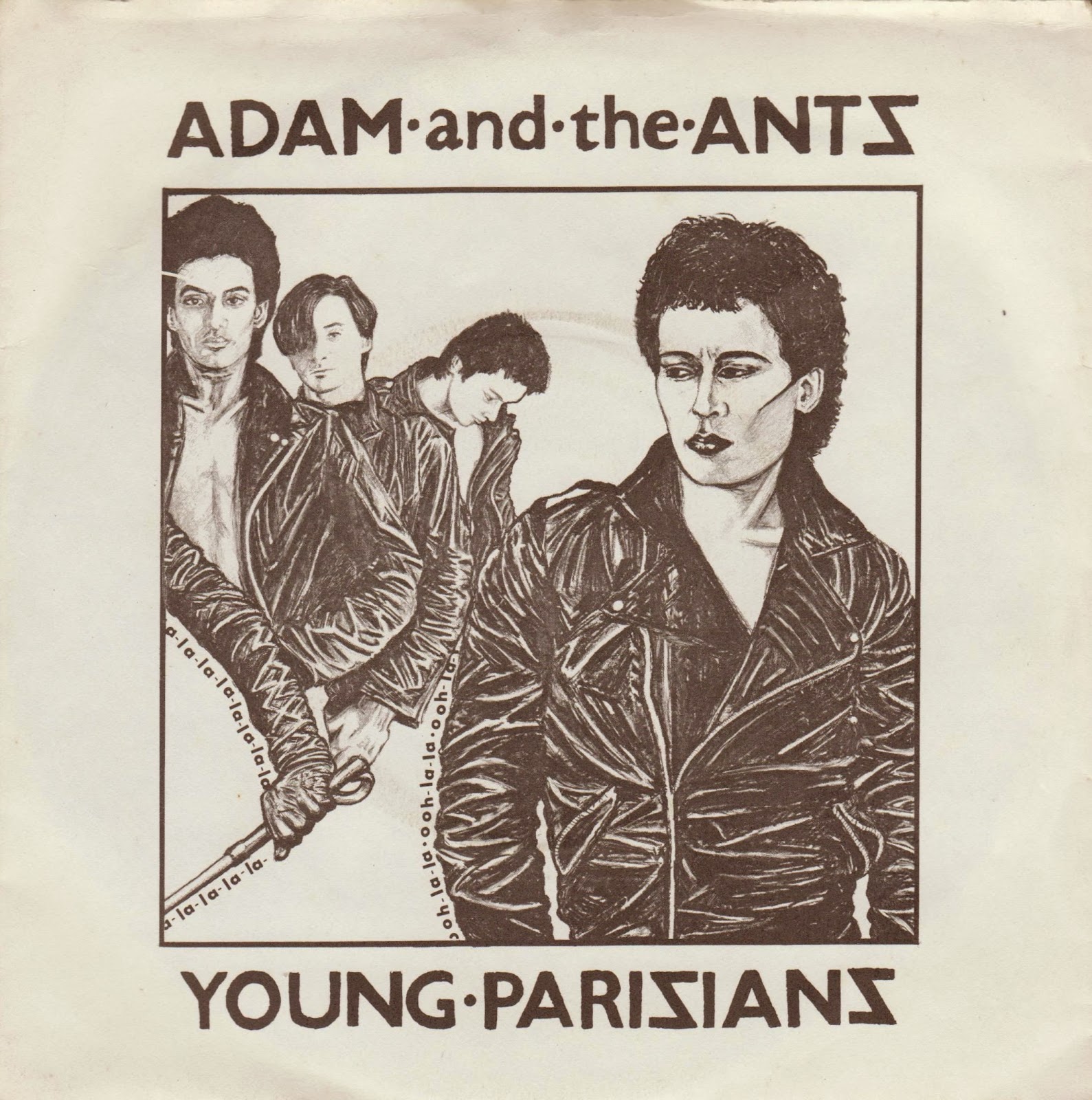
500 Singles - Numbers 4 and 5 - Adam & The Ants - Stand and deliver, Young Parisians


You have to have some sympathy for Adam Ant, the punk upstart who sought guidance from punk’s best known svengali, Malcolm McClaren, who promptly conspired with his group, The Ants, to sack their lead singer and become, essentially, Bow Wow Wow. Adam and his new Ants came out fighting though and for a brief period during the early 1980s became an act that were simultaneously mainstream and potentially disturbing at the same time. (Imagine 1 Direction being painfully open about their love of S&M and including tracks like ‘Mile High Club’ and ‘S.E.X.’ on their albums and you’ve got some idea of the balance of acceptability and danger that Adam had at the time). Adam’s rise was stratospheric, but his time at the top of pop’s tree was reasonably brief with not much to write home about outside his releases (and re-releases) in 1980 and 1981; Adam and the boys’ Christmas single in 1981 is one of the most excruciating ‘white people rapping’ songs you’re ever likely to hear, but if you were around at the time you’re highly unlikely to forget, courtesy of this single, that the group at the time consisted of ‘Marco, Merrick, Terry Lee, Gary Tibbs and Yours Truly’.

Andrew and I saw the ‘Prince Charming Revue’ at Newcastle City Hall and it was a memorable spectacle, walking the plank between punk, glam rock, theatre and pantomime. Sometimes it fell off.
 
Thanks for reading and, don't forget, my Kindle book is still available by clicking on this nifty little link;

The Great Cassette Experiment - The Joy Of Cassettes